GR00T N1.7 keeps 93.85% average LIBERO success at 1.5 bits per language/action weight, 0.25 points from BF16, while resident model memory drops 4.83× and, with 8-bit activations (W1.5A8), inference runs 1.51× faster than BF16.
Headline results
LIBERO average success · 1.5 L/A bpw
93.85%
BF16 reference 94.10%
Resident model memory · SACQ-1.5b
1.175GB
BF16 5.677 GB · 4.83× smaller
Inference latency · SACQ (W1.5A8)
14.07ms
BF16 21.28 ms · 1.51× faster
(a) GR00T N1.7 success rate on LIBERO
(b) GR00T N1.7 memory and inference efficiency
SACQ performance and efficiency on GR00T N1.7.(a) SACQ maintains near-BF16 LIBERO performance down to 1.5 language/action bits per weight (W1.5), outperforming the baselines at lower bit budgets. (b) SACQ at W1.5 reduces model memory by 4.83×, while W1.5A8 achieves a 1.51× speedup over BF16. A16/A8 denote the 16-/8-bit activation settings, respectively. Hover a mark for its exact value.Quantization scope and how bits are counted
L/A bpw is the nominal, parameter-weighted average over the 338 language-backbone and action-head candidate linear layers (112 + 226) and excludes codebook and scale metadata; allocation itself is driven by the calculated storage including that metadata. The remaining 128 linear layers and the token embedding are fixed at 4-bit; activations remain BF16. Memory is the resident footprint of the full loaded policy. The GPTQ series includes a custom ternary extension at log2(3) ≈ 1.585 bpw; the 2- and 3-bpw points use standard GPTQ. “TWLA” is the TWLA-compatible PyTorch port described in the paper. Each configuration uses 500 episodes per LIBERO suite. Latency is whole-model inference latency measured with the official GR00T inference path on an RTX 4090 at batch size 1 with four denoising steps: wall-clock time with GPU synchronization before and after each model call, the median of 20 measurements after five warmup iterations, excluding preprocessing. BF16 uses the same common runtime optimizations and CUDA Graph execution as the SACQ settings.
Abstract
Vision-Language-Action (VLA) models enable capable robot behavior, but their large memory footprint limits deployment on resource-constrained robotic platforms. Weight quantization is a natural remedy, yet post-training quantization (PTQ) recipes inherited from large language models degrade when applied to VLAs at ultra-low precision. Existing low-bit PTQ methods often fail to explicitly account for the structure of downstream operations and allocate precision without considering its effect on the policy actions. We introduce SACQ, an ultra-low-bit weight-only vector-codebook quantization framework for VLAs. SACQ combines (1) structure-aware codebook fitting with role-specific quadratic metrics that reflect input statistics and downstream sensitivity; (2) action-aware mixed-bit allocation based on the increase in final-action error as individual layers are compressed; and (3) two-stage post-quantization refinement that reassigns codeword indices with second-order error compensation and calibrates codebooks and row-group scales against the decoded action. Using GR00T N1.7, SACQ achieves 93.85% average success across four LIBERO suites at 1.5 bits per language/action weight while reducing model memory by 4.83×. With INT8 activation quantization and low-precision attention, it retains 93.55% success while running 1.51× faster than BF16. On SimplER, SACQ further achieves 63.76% and 52.27% success under Visual Matching and Variant Aggregation at 2 bits per language/action weight, compared to 58.90% and 53.45% for BF16, respectively.
Method
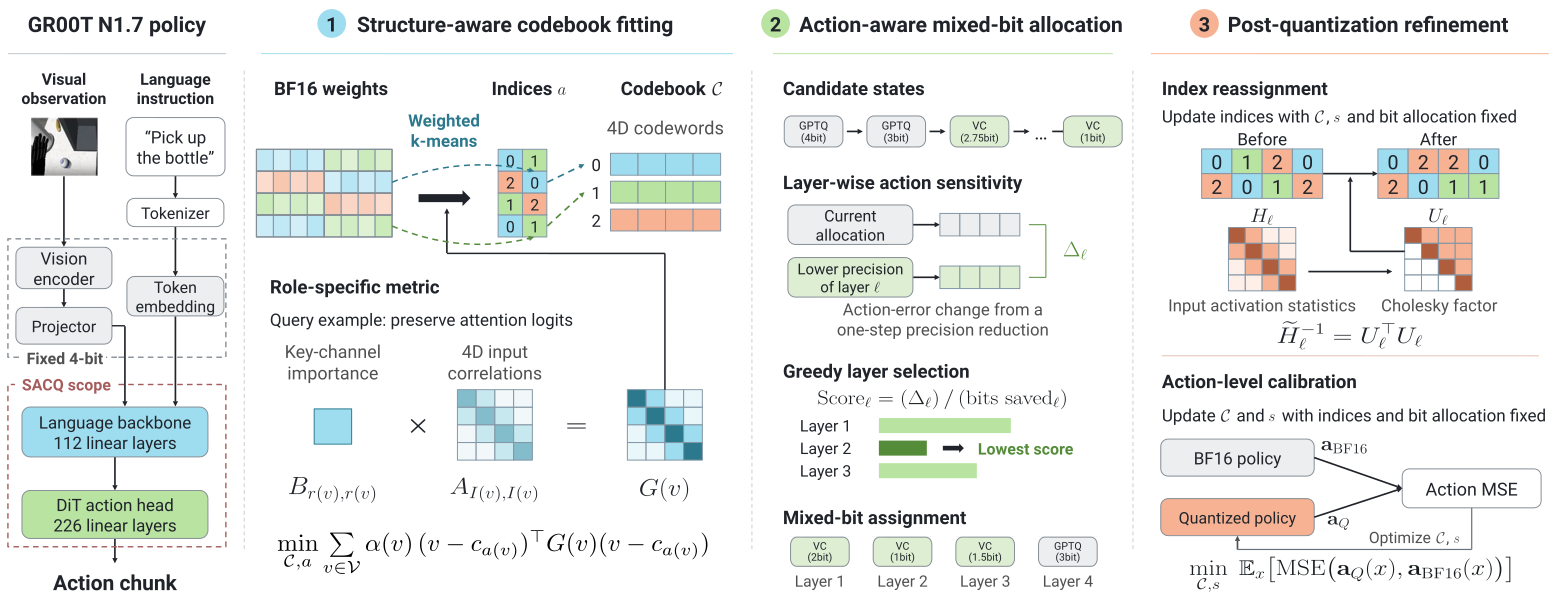
SACQ uses a block-scaled vector-codebook representation: weights are split into row groups of g = 64 entries normalized by their own scale, grouped into d = 4-dimensional vectors, and each vector stores one index into a single per-layer codebook. Its three components connect the local structure of each projection to the action produced by the full policy.
Overview of SACQ. (1) Structure-aware codebook fitting fits each codebook using a projection-specific metric that reflects both input statistics and downstream sensitivity. (2) Action-aware mixed-bit allocation assigns precision according to the increase in final-action error per bit saved. (3) Two-stage post-quantization refinement reassigns codeword indices using second-order error compensation, then calibrates the codebooks and row-group scales against the decoded action with the updated indices fixed.
1
Structure-aware codebook fitting
Fitting a codebook means choosing codewords and assignments that minimize a distortion over all vectors. Euclidean distance treats every coordinate alike; SACQ instead measures each vector’s error with its own positive semidefinite matrix G(v), which encodes which errors to accept and which to avoid, under a per-vector weight α(v) ≥ 0:
Setting α(v) = s(v)2 would weight each vector by its block scale in the original weight space; SACQ sets α(v) = 1 and fits directly in the scale-normalized space. The metric is derived from the operation that consumes each projection, not from the projection output itself. For a query projection, the error is measured at the attention logits, which introduces an output-side weighting from the keys; the key projection mirrors it. Value errors are weighted by the attention probabilities and the output projection. Gate and up projections pass through SwiGLU and the down projection, giving first-order diagonal sensitivities. To keep fitting separable, SACQ keeps the diagonal of the output-side weighting and the 4×4 input block of the vector:
Here A is the input-side Gram and B the output-side weighting of the role. The DiT action head follows the same principle with separate query- and key/value-side statistics in cross-attention, GELU feed-forward sensitivities, and an output-side weighting for AdaLN modulation. Given G(v), the codebook is optimized by alternating metric-weighted assignment and weighted least-squares codeword updates.
Role-specific metrics for every projection
Metric construction for the seven language-backbone roles. Head and group indices are omitted; the computation applies normalization, RoPE, and GQA repetition or aggregation.
Projection
Input-side Gram A
Output-side weighting Brr
q proj
k proj
v proj
o proj
1
down proj
1
gate proj
up proj
Metric construction for the seven DiT action-head roles. xq and xkv are the query-side and key/value-side attention inputs, which coincide in self-attention. The two output projections (proj_out_1, proj_out_2) use Euclidean vector k-means.
Projection
Input-side Gram A
Output-side weighting Brr
Q
K
V
O
1
FF-up
FF-down
1
AdaLN
2
Action-aware mixed-bit allocation
Each candidate layer moves through a chain of states ordered by precision, GPTQ (4bit) → GPTQ (3bit) → VC (2.75bit) → VC (2.5bit) → ⋯ → VC (1bit), where VC (rbit) is a vector-codebook state with nominal rate r bits per weight and codebook size 2dr; the 1-bit operating point additionally allows VC (0.75bit). Only transitions between adjacent states are allowed. For each layer ℓ, SACQ measures Δℓ, the increase in final-action relative error when that layer alone is moved one state down, by actually running the policy on the calibration set with equal weighting across suites.
Storage is counted as calculated bits per weight including codebooks and row-group scales, since this overhead is not negligible at low rates. At each greedy step, SACQ selects the component (language backbone or action head) with the higher calculated bits per weight and, within it, the layer with the smallest action-error increase per bit saved:
This component-balancing rule prevents either part of the policy from being compressed disproportionately. Sensitivities are refreshed every 100 accepted moves, so the procedure is a periodically refreshed greedy search rather than a globally optimal allocation.
3
Two-stage post-quantization refinement
Both stages apply only to vector-codebook layers; layers that remain in GPTQ states are kept fixed. The two mechanisms play different roles: G(v) guides projection-specific codebook fitting, while index reassignment compensates cross-vector quantization errors.
Index reassignment.
With codebooks, scales, and the bit allocation fixed, SACQ runs the frozen quantized policy on calibration data, collects the input second-moment matrix Hℓ of each target layer, and takes the Cholesky factor Uℓ of its damped inverse. Vectors are reassigned sequentially against the original BF16 weight; the residual of each assignment is propagated to the remaining coordinates so later vectors absorb earlier error:
Action-level calibration.
With the updated indices a∗ frozen, only the codebooks C and row-group scales s are optimized so that the quantized policy matches the BF16 action. Keeping the indices fixed preserves the storage rate during calibration:
Calibration uses AdamW on 576 training requests per LIBERO suite (64 held for validation) for 12 epochs, selecting the checkpoint with the lowest validation relative action error. The same policy-noise seed is used for the quantized and BF16 policies when computing the loss.
Experiments
We quantize 338 linear layers of GR00T N1.7 (112 language-backbone and 226 DiT action-head layers) while keeping the remaining 128 linear layers and the token embedding at 4-bit; except for the A8 inference setting, activations remain BF16, with BF16 as the full-precision reference. We compare against HQQ, GPTQ, ActQuant, TWLA, and AQLM under the same language/action scope; calibration-based methods use the same calibration data as SACQ and follow their own quantization and optimization procedures. Evaluation uses the four LIBERO suites (500 episodes each, environment seed 17) and the SimplER Google Robot Visual Matching and Variant Aggregation protocols (seed 7). We then measure inference efficiency at W1.5, and check that the behavior carries over to OpenVLA-OFT, a different VLA architecture, and to GR00T N1.7 under the LIBERO-Pro perturbations.
GR00T N1.7 on LIBERO
Paper · Table 1
SACQ achieves 93.85% average success at 1.4998 L/A bpw, only 0.25 percentage points below the 94.10% BF16 reference, and reaches 94.25% and 94.10% at 2 and 3 bpw. For comparison, TWLA and AQLM reach 93.05% and 83.60% at 2 bpw, AQLM reaches 87.50% at 1.5 bpw, and ActQuant and GPTQ-Ternary fall to 30.05% and 31.95% there. At 1.4998 L/A bpw, resident model memory drops from 5.677 GB to 1.175 GB.
Comparison of SACQ with existing quantization methods on GR00T N1.7 across the four LIBERO suites. Success rates (%) against HQQ, GPTQ, ActQuant, TWLA, and AQLM at comparable language/action bit budgets. L/A bpw is the parameter-weighted average bits per weight over the 338 language-backbone and action-head candidate layers.
Method
L/A bpw
Spatial
Object
Goal
Long
Avg.
Memory (GB)
BF16
16.0000
94.2
97.6
95.2
89.4
94.10
5.677
~3 bpw
HQQ
3.0000
75.0
93.6
76.4
73.8
79.70
1.660
GPTQ
3.0000
95.2
97.4
96.6
85.6
93.70
1.982
ActQuant
3.0011
94.8
96.2
96.4
90.4
94.45
1.562
AQLM
3.0000
93.6
97.4
92.4
79.4
90.70
1.551
SACQ-3b
2.9990
94.8
96.8
96.6
88.2
94.10
1.902
~2 bpw
HQQ
2.0000
0.0
0.0
0.4
0.0
0.10
1.368
GPTQ
2.0000
57.2
90.2
49.8
60.2
64.35
1.528
ActQuant
2.0006
92.2
96.6
88.6
67.8
86.30
1.306
TWLA †
2.0489
93.6
97.4
96.4
84.8
93.05
2.772
AQLM
2.0000
93.0
95.0
76.4
70.0
83.60
1.599
SACQ-2b
1.9997
93.8
96.6
97.0
89.6
94.25
1.310
~1.5 bpw
GPTQ-Ternary ‡
1.5850
39.4
44.4
10.6
33.4
31.95
1.337
ActQuant
1.4986
48.4
35.4
26.6
9.8
30.05
1.169
AQLM
1.5000
89.8
96.4
88.0
75.8
87.50
1.138
SACQ-1.5b
1.4998
93.2
97.0
96.2
89.0
93.85
1.175
~1.25 bpw
SACQ-1.25b
1.2487
92.0
96.8
94.4
87.6
92.70
1.114
~1 bpw
SACQ-1b
1.0000
86.8
93.6
86.2
65.6
83.05
1.069
Bold marks the best result within each bit-budget group. † TWLA-compatible is a PyTorch VLA port that does not reproduce all storage/runtime optimizations of the original implementation. ‡ GPTQ-Ternary is a custom symmetric ternary extension with GPTQ-style error compensation. ActQuant’s allocation and scale optimization are applied to the same candidate layers, including the DiT action head. AQLM uses the official implementation with group size 8 and 1×12, 1×16, and 2×12 codebooks for the 1.5-, 2-, and 3-bit budgets; its 2-bit 1×16 codebook (65,536 entries per layer) carries more metadata than the 3-bit 2×12 one, which is why its resident memory is slightly higher at the lower nominal rate.
GR00T N1.7 on SimplER Google Robot
Paper · Table 2
At 2 L/A bpw, SACQ achieves 63.76% on VM and 52.27% on VA, compared with BF16 references of 58.90% and 53.45%, and exceeds every evaluated quantized baseline under both protocols. Reducing SACQ to 1.4999 L/A bpw gives 57.20% on VM and 44.67% on VA.
Visual Matching (VM). Comparison of SACQ with existing quantization methods on the SimplER Google Robot benchmark using GR00T N1.7. Success rates (%) under the Visual Matching (VM) and Variant Aggregation (VA) protocols against GPTQ, ActQuant, TWLA, and AQLM at comparable language/action bit budgets.
Method
L/A bpw
Pick
Move
Drawer
Apple
Avg.
Memory (GB)
BF16
16.0000
86.00
91.25
45.37
12.96
58.90
5.677
GPTQ
2.0000
70.33
25.00
6.94
0.00
25.57
1.524
ActQuant
1.9998
90.67
62.92
32.87
0.00
46.61
1.331
TWLA †
2.0635
84.00
72.08
47.22
7.41
52.68
2.782
AQLM
2.0000
73.33
26.25
24.54
0.00
31.03
1.595
SACQ-2b
1.9995
91.33
89.17
49.54
25.00
63.76
1.342
SACQ-1.5b
1.4999
84.67
73.75
38.89
31.48
57.20
1.191
Variant Aggregation (VA). Comparison of SACQ with existing quantization methods on the SimplER Google Robot benchmark using GR00T N1.7. Success rates (%) under the Visual Matching (VM) and Variant Aggregation (VA) protocols against GPTQ, ActQuant, TWLA, and AQLM at comparable language/action bit budgets.
Method
L/A bpw
Pick
Move
Drawer
Apple
Avg.
Memory (GB)
BF16
16.0000
83.27
81.83
21.69
26.98
53.45
5.677
GPTQ
2.0000
67.88
23.00
2.12
0.00
23.25
1.524
ActQuant
1.9998
76.97
64.33
11.38
2.12
38.70
1.331
TWLA †
2.0635
79.88
68.83
14.29
29.63
48.16
2.782
AQLM
2.0000
65.82
32.50
5.29
0.00
25.90
1.595
SACQ-2b
1.9995
80.73
77.83
17.72
32.80
52.27
1.342
SACQ-1.5b
1.4999
75.39
74.17
4.76
24.34
44.67
1.191
VM comprises 864 evaluation conditions and VA 1,992, each covering four task categories: Pick, Move, Drawer, and Apple. Only the first action of each predicted chunk is executed.
Inference efficiency at W1.5
Paper · Table 3
At 1.5 L/A bpw (W1.5), we evaluate two activation-precision settings: a 16-bit activation setting (W1.5A16) and an 8-bit activation setting (W1.5A8). In A8, linear projections use dynamic per-row symmetric INT8 activation quantization with INT8 GEMMs, while action self-attention and vision attention use an INT8-QK/FP8-PV attention path; the attention cores in action cross-attention and language attention remain in BF16. The runtime additionally uses optimized packed-weight decoding kernels and CUDA Graph execution while retaining SACQ’s compressed weight representation. For a fair comparison, BF16 uses the same common runtime optimizations and CUDA Graph execution.
W1.5A8 achieves 93.55% average success on LIBERO, only 0.30 percentage points below W1.5A16 and 0.55 below BF16, while running 1.51× faster than BF16. Latency is whole-model inference latency on an RTX 4090 with batch size 1 and four denoising steps, measured with the official GR00T inference path: wall-clock time with GPU synchronization before and after each model call, reported as the median of 20 measurements after five warmup iterations, excluding preprocessing.
Inference efficiency of SACQ on GR00T N1.7 across the four LIBERO suites. Task success rates (%), whole-model inference latency, and relative speed with respect to BF16.
Configuration
Spatial
Object
Goal
Long
Avg.
Latency (ms)
Relative speed
BF16
94.2
97.6
95.2
89.4
94.10
21.28
1.00×
SACQ (W1.5A16)
93.2
97.0
96.2
89.0
93.85
20.20
1.05×
SACQ (W1.5A8)
93.8
96.2
95.4
88.8
93.55
14.07
1.51×
Relative speed is with respect to BF16, which runs with the same runtime optimizations.
OpenVLA-OFT on LIBERO
Paper · Table 7
Applying SACQ to a different VLA architecture, where the quantization scope covers 420 vision and language linear layers and excludes the MLP action head, gives 95.55% average success at 3 V/L bpw and 94.05% at 2 V/L bpw against a 95.80% BF16 reference. V/L bpw is not directly comparable to GR00T’s L/A bpw.
Cross-architecture evaluation on OpenVLA-OFT. Success rates (%) across the four LIBERO suites. V/L bpw denotes the quantization rate over the 420 vision and language linear layers. Bold marks the best result within each comparable bit-budget group.
Method
V/L bpw
Spatial
Object
Goal
Long
Avg.
Memory (GB)
BF16
16.0000
93.8
98.2
97.2
94.0
95.80
15.203
~3 bpw
SACQ-3b
2.9988
91.8
97.4
97.8
95.2
95.55
5.128
~2 bpw
GPTQ
2.0000
67.6
55.8
73.6
49.6
61.65
3.625
ActQuant
2.0000
79.6
60.8
77.2
24.8
60.60
2.953
TWLA †
2.1115
91.0
96.4
96.2
93.8
94.35
8.960
SACQ-2b
2.0000
92.0
96.0
98.0
90.2
94.05
2.926
~1.5 bpw
GPTQ-Ternary ‡
1.5850
0.0
0.0
0.0
0.0
0.00
3.026
ActQuant
1.5000
61.6
31.2
35.2
0.0
32.00
2.433
SACQ-1.5b
1.4989
89.4
95.0
92.8
65.6
85.70
2.463
GR00T N1.7 on LIBERO-Pro
Paper · Table 8
Under five perturbation families (Language, Object, Swap, Task, Environment) evaluated over 10,000 episodes per model, the 3-bit and 2-bit SACQ models stay within 0.1 percentage points of BF16, and the 1.5-bit model within about one point.
Evaluation of GR00T N1.7 on LIBERO-Pro. Success rates (%) are aggregated over the five perturbation families (Language, Object, Swap, Task, Environment) for each LIBERO suite; 10,000 episodes per model.
Method
L/A bpw
Spatial
Object
Goal
Long
Avg.
BF16
16.0
44.60
41.28
45.52
43.28
43.67
SACQ-3b
3.0
44.44
41.04
45.56
44.00
43.76
SACQ-2b
2.0
44.60
41.08
44.48
44.32
43.62
SACQ-1.5b
1.5
43.64
40.72
43.24
42.88
42.62
Analysis
Component ablation on LIBERO
Paper · Table 4
At 1.5 L/A bpw, Euclidean VQ with mixed-bit allocation fails to preserve the policy entirely, whereas structure-aware fitting raises the pre-refinement average to 47.50%. Refinement then recovers the full model to 93.85%. Removing structure-aware fitting or mixed-bit allocation from the full pipeline lowers the final success to 92.60% and 93.25%. The effect grows under more aggressive compression: at 1.25 L/A bpw, structure-aware fitting lifts the average from 87.65% to 92.70%, with LIBERO-Long improving from 73.2% to 87.6%.
Component and structure-aware ablations of SACQ on LIBERO. The three components are evaluated at 1.5 L/A bpw and structure-aware fitting at 1.25 L/A bpw.
Setting
Alloc.
Struct.
Refine.
Spatial
Object
Goal
Long
Avg.
BF16
–
–
–
94.2
97.6
95.2
89.4
94.10
1.5 L/A bpw
Uniform Euclidean VQ
–
–
–
0.0
0.0
0.0
0.0
0.00
+ Mixed-bit allocation
✓
–
–
0.0
0.0
0.0
0.0
0.00
+ Structure-aware fitting
✓
✓
–
44.8
73.4
31.4
40.4
47.50
Full SACQ-1.5b
✓
✓
✓
93.2
97.0
96.2
89.0
93.85
w/o Struct. (Euclidean)
✓
–
✓
95.2
95.8
93.8
85.6
92.60
w/o Allocation (Uniform)
–
✓
✓
94.2
96.8
95.8
86.2
93.25
1.25 L/A bpw
w/o Struct. (Euclidean)
✓
–
✓
91.8
94.4
91.2
73.2
87.65
Full SACQ-1.25b
✓
✓
✓
92.0
96.8
94.4
87.6
92.70
Structure-aware fitting under limited refinement
Paper · Table 9
With the mixed-bit allocation fixed and refinement held at 12 epochs, three codebook-fitting objectives are compared as the calibration data per suite shrinks from the full 2,880 observations to 90. With 90 observations, structure-aware fitting reaches 84.15% average success versus 74.55% for layer-local reconstruction and 39.75% for Euclidean fitting. The gap narrows as data grows, and at the full budget structure-aware fitting recovers LIBERO-Long to 89.0%, closest to the 89.4% BF16 reference.
Suite
Success (%) versus calibration observations per suite at 1.5 L/A bpw with refinement fixed to 12 epochs. The dashed reference marks BF16. Values are listed in the table below.Table view of the limited-refinement study
Codebook fitting under limited post-quantization refinement at 1.5 L/A bpw. Calibration data per LIBERO suite is varied while refinement is fixed to 12 epochs. Delta is the difference in four-suite average success relative to structure-aware fitting under the same calibration budget.
Calib. data
Fitting
Spatial
Object
Goal
Long
Avg.
Δ vs. Struct.
–
BF16
94.2
97.6
95.2
89.4
94.10
–
90
Structure-aware
76.2
94.6
88.0
77.8
84.15
0.00
Layer-local
61.8
95.0
71.8
69.6
74.55
-9.60
Euclidean
42.2
48.6
35.0
33.2
39.75
-44.40
180
Structure-aware
86.0
95.8
90.6
83.0
88.85
0.00
Layer-local
78.8
96.4
87.6
73.4
84.05
-4.80
Euclidean
48.2
87.4
52.0
41.0
57.15
-31.70
360
Structure-aware
91.2
96.6
94.0
81.0
90.70
0.00
Layer-local
87.0
97.2
88.2
80.0
88.10
-2.60
Euclidean
78.4
95.2
77.2
63.4
78.55
-12.15
720
Structure-aware
91.8
96.2
93.0
84.0
91.25
0.00
Layer-local
90.6
95.8
94.2
85.2
91.45
+0.20
Euclidean
87.8
94.2
88.4
75.4
86.45
-4.80
1,440
Structure-aware
93.2
97.6
93.8
85.6
92.55
0.00
Layer-local
92.6
97.4
95.0
86.8
92.95
+0.40
Euclidean
93.6
97.6
91.6
79.6
90.60
-1.95
2,880
Structure-aware
93.2
97.0
96.2
89.0
93.85
0.00
Layer-local
92.6
97.0
95.0
85.8
92.60
-1.25
Euclidean
95.2
95.8
93.8
85.6
92.60
-1.25
Limitations. Evaluation is limited to simulation benchmarks; validation on real robotic systems remains an important direction for future work.